Showing posts with label Shrine/Temple. Show all posts

Friday, March 30, 2007

Cherry Blossoms at Kuonji Temple, Yamanashi pref.

Long time!
*************

Kuonji Temple is famous for weeping cherry blossoms.


After going up 287 steep stone stairs, you will be greeted by beautiful weeping cherry blossoms planted in the precincts.


Near Kuonji Temple, there are several temple lodgings (shukubo in Japanese). Each of them also has beautiful cherry trees. You can take a rest there with a hospitality of a cup of hot cherry water.


Kuonji Temple was founded by Nichiren in Kamakura era. His mausoleum was 20-minute walk from the temple. It entrance was decorated by cherry trees.


The nearest JR station is Minobu. The steet in fornt of ths station is called Shonin Street, derived from Nichiren Shonin. At both sides of the street, there were stores, each drawing its own family crest on the wall.

Sunday, February 04, 2007

Setsubun

Spring started today according to the old calendar; so yesterday was Setsubun which means the end of winter. At major temples around the country, bean-scattering ceremony took place. Men and women of year scatter beans to drive away evil spirits, saying, “Fortune in and demons out.”

I visited Kenchoji Temple in Kamakura. Before bean-scattering ceremony, dance performance was dedicated there. The lion dance and “Kappore” dance were performed by more that sixty men and women. They act to preserve this Edo dance performance. It was interesting to perform Edo dance in Kamakura.

For more information about Setsubun, please access to my Web site:


http://www.realjapan.org/life/event/februaryevent.html


(Kappore Dance)

(Kappore Dance)

(Bean Scattering Ceremony)

(Bean Scattering Ceremony)

(Lion Dance)

Monday, December 25, 2006

Autumn Colors in Kyoto

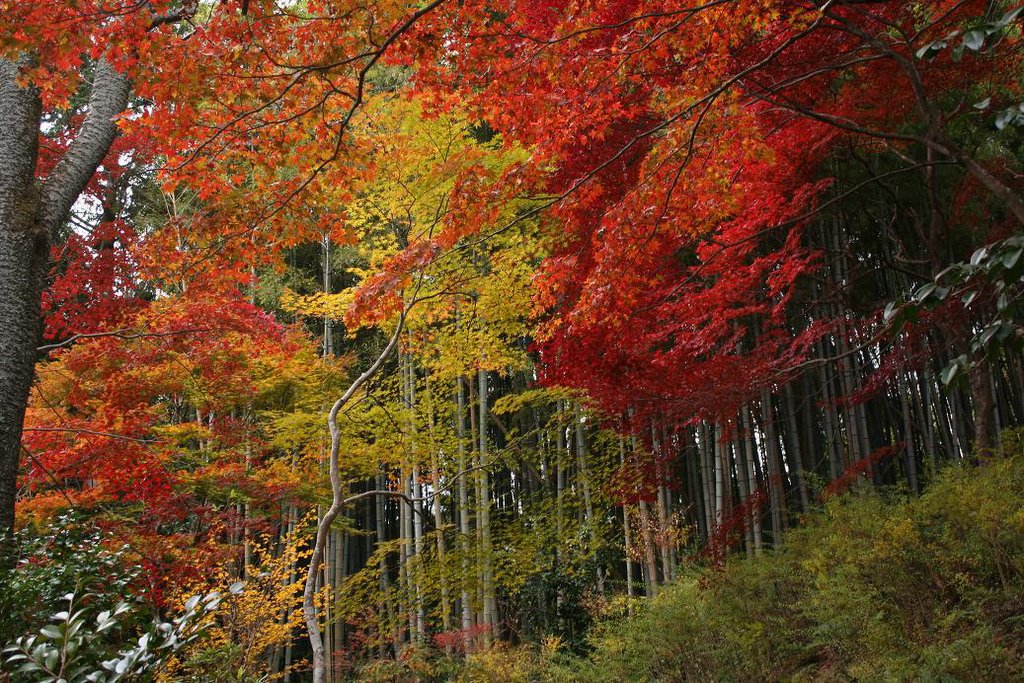
I have received an unexpected X'mas present from my friend, Yu-kun. At the end of last month he visited Kyoto and taken pictures of autumn colors. He visited Shozan Garden in the north and Komyoji Temple in the west of Kyoto.

More photos can be seen in my Web site. Please access:
http://www.realjapan.org/photo/Kyoto2006Autumn/index.html


(Shozan Garden)

(Shozan Garden)

(Komyoji Temple)

(Komyoji Temple)

Monday, November 20, 2006

Miyajima (or Itsukushima)

Miyajima is one of Japan’s three most beautiful spots. Itsukushima Shrine and the surrounding sea and primeval forest were designated as a World Cultural Heritage in 1996.

About ten-minute boat from Miyajimaguchi takes us to the island. A red-painted shrine gate standing in the sea surprises us and makes us feel like coming to another world.
Within Itsukushima Shrine, we have to take one-way route, but we can tour at a leisurely pace. Also you can realize that the shrine is built in the sea. When I visited there, I got up early in the next morning and went to the shrine gate. I could reach the gate on foot. Do not forget to check the time of greater ebb.

There are a lot of deer in Miyajima. People take good care of deer, because deer has been considered a divine messenger. How friendly! You will be surprised to see them here and there. On the top of Misen there are a lot of monkeys. They are not friendly; be careful.
If you visit in autumn, you can further enjoy autumn colors. I recommend a walk around Momijidani Park.

If you are going to stay in Miyajima, you should know that there are no convenience stores there. Most stores are closed around 6 p.m. I had reserved only accommodation. As the owner introduced me a couple of restaurants, I was able to have a dinner. My breakfast was momiji-manju. I bought it at a souvenir shop that was open early in the morning for tourists. Momiji-manju is maple-shaped bun with bean-jam filling and specialty of Miyajima. Another specialty is oyster. You can see the oyster bed from the boat. Try to eat various oyster dishes. I can never forget kaki-no-dotenabe (oyster-in-pan dish dressed with miso sauce) and Suishin (Hiroshima’s sake) that I had at Hiroshima Station.


(Red-painted Shrine Gate)

(Shrine Gate at Greater Ebb)


(Dear Deer Couple)


(Oyster Bed)

Sunday, January 08, 2006

Ritual at Tsurugaoka Hachimangu Shrine in Kamakura

I like Kamakura and I take a walk in and out of the town 5 or 6 times a year. There are a lot of nice places.
What I’ll show you today is a ritual called “Joma-Shinji.” Several years ago I happened to see this ritual at Tsurugaoka Hachimangu Shrine on New Year's Days. Minamoto-no-Yoritomo, who established the Kamakura Shogunate, moved a shrine which his ancestor had reared, and worshipped the Hachimangu Shrine as a guardian god of Minamoto family. Joma-Shinji is a rutual for a professional archery to put an arrow in the target in order to expel the evil spirits.


Wednesday, January 04, 2006

Visiting a temple

Many of the Japanese visit a temple or shrine on New Year’s Day to make wishes of the coming year. I went to Kawasaki Daishi Heikenji Temple in Kawasaki City next to Tokyo. The temple ground was crowded, though today kicked off another year of work at a lot of companies. The number of new year visitors to Kawasaki Daishi in 2005 ranks third in Japan. (Meiji Shrine ranks first.)


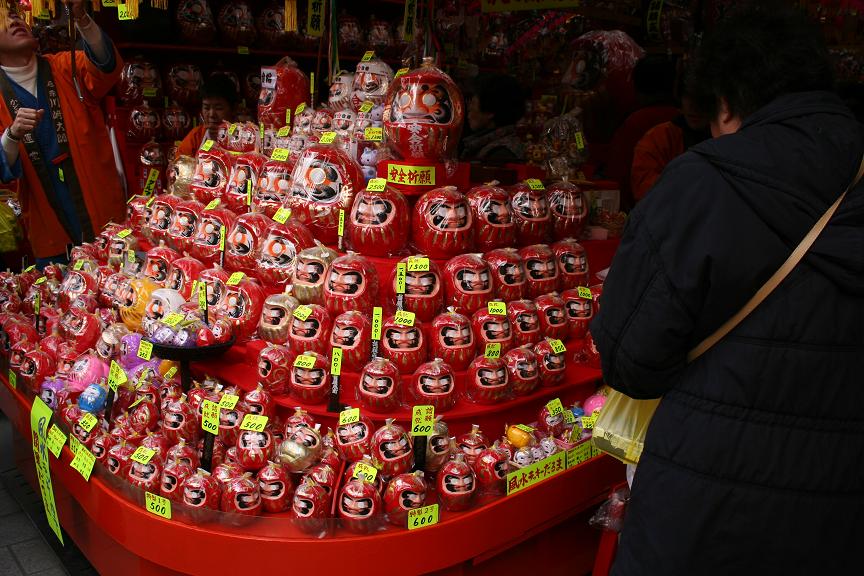
There are several Dharma doll shops near the temple. Dharma dolls are derived from the Buddhism sage, Dharma. The Japanese have the custom of drawing one eye on a Dharma doll when they make a wish, and drawing the other eye after they fulfill the wish. I bought a small Dharma doll. It cost 250 yen. I think the size of a doll will not affect the grace......

Friday, December 16, 2005

Kyoto in Autumn

The temple in Kyoto I recommend most is Jojakkoji Temple located at Sagano, western area in Kyoto. You can see the autumn color of leaves everywhere in the temple grounds and have a quiet time sitting on a bench.


This autumn I went to Kyoto and visited some temples not so popular, that is, not so crowded. Even on weekdays streets are full of travelers in this season. I visited a small temple called Jikishian located at northern Saga. This was added to my favorite autumn leaves view points.